Winning


Since my last blog I played a lot of poker in Vegas. Too much to blogify.
So for this one I thought I'd do deep analysis on 5 hands I played in my notable tournaments. I will start with some simple strategy that hopefully makes sense to non-poker nerds reading this (it won't). Then I'll spice in some ideas from solverland before launching into my true feelings.
It's poker poker poker and it's going to run a bit long. I promise I'll be back to short stupid stuff soon.
Punt Return
WSOP Salute to Warriors Day 1
June 21st
$500 entry, 50k starting stack, 40m levels

Simple Strategy
In this hand I'm in late position with QJs facing a raise and a call. When we're this deep the hands we want to squeeze as a bluff will be the suited connected hands that play well postflop. So I like this hand selection.
The BTN here cold calls the squeeze which is generally bad in tourneys but when you're this deep and on the BTN it can be okay especially if the other players are passive and unlikely to 4-bet. The overcalls from the early position player and HJ are suspicious.
When we flop this non-nut flush it's best to bet, not trap. We want to build a pot before any scare cards arrive. There are many hands that will continue here - primarily overpairs and any one ❤️ hands.
On the turn there's not much to think about. We have to get it in here.
Solver Ideas
Solver agrees with me preflop. The squeeze range preflop is linear mixing suited stuff and pocket pairs with very few offsuit hands:

Once the BTN cold calls we've left solverland. But in multiway spots typically we do prefer cbet with the flopped 3rd nut flush.
Deeper Thoughts
I saw a Daniel Negreanu vlog this summer where he was talking about the old school tournament mentality of playing conservative and waiting for the bad players to give you the chips. His point was that people are better at poker now so this approach does not work.
Well... that depends on what tournaments you are playing.
In the $500 Salute To Warriors and a lot of low stakes tournaments in general you will still encounter some awful players. Early in these tournaments you should expect recs to exhibit these tendencies:
Loose passive preflop
Overplaying their marginal hands postflop
So in these fields you do want to underbluff many spots and wait for the weak players to punt it off to you. This hand is a great example.
The majority of your EV comes from realizing all your equity when your opponents are too passive and then winning heaps when you do make a big hand because the fish will never fold a strong pair.
Tournament Summary
Day 1 in this I caught several punts and had a huge stack all day. In one spot I flopped a nut flush and a guy check-jammed 2x pot into me.
On Day 2 I blundered in a hand where I 4b JJ and then leveled myself into folding when he jammed. He had AK and I may have busted there but I also may have won a chip lead pot and made a much deeper run.
Later I got coolered on successive hands to bow out in 82nd out of 4,458 players for $2,330.
The Shiny Wheel
Wynn NLH Day 1
July 7th
$2200 Entry, 40k starting stack, 40m levels

Simple Strategy
52s is not a very strong hand and you can just fold this one in all positions except defending the BB.
On the flop this is a no-brainer cbet when we have all the strong hands in our 3b range and our actual hand is a low equity holding with some outs to the nuts that would love to induce a fold.
When we turn the nuts this is a spot we never want to slow play because we unblock all of our opponent's strong hands. We need to make sure we get all in by the river when we're up against a hand that will never fold.
Solver Ideas
BTN vs CO is going to be our widest 3b spot. GTOW says 11.3% 3b here at 100bb and is mixing with a wide variety of hands including some small suited connectors like 54s.

In response CO should be 4-betting 16% of the time including most of the time with AQo.

Deeper Thoughts
There's a poker exploit that says when players are too passive in one node of the game tree, you get to be more aggressive in the prior node. That means that if they aren't 3-betting enough, you get to raise first in wider. If they aren't 4-betting enough, you get to 3-bet wider. If they aren't check-raising enough, you get to c-bet wider.
At all stakes except the very highest you can expect that humans are 4-betting less than a solver recommends. That means you can 3-bet wider.
Alex Foxen says that he has played a 20% 3-bet strategy profitably across all stakes. This only works because people aren't 4-betting enough.
I don't 3b as aggressively as Foxen but I am wider than GTO. When I'm deep stacked the hands I add are mostly suited and at least somewhat connected.
I'm not pure 3-betting the 52s but I will mix it in as a 3-bet from all positions. The small suited stuff is nice because you can rep the broadway boards and get folds but also make strong hands on low boards and get lots of calls.
When you show down a hand like 52s that you 3b preflop you cultivate a "bad" image which allows you to get paid later when you get dealt strong hands.
Tournament Summary
I had a terrible image early in this one and then KOed everyone who was at the table when I arrived. Late in Day 1 I lost some tough all ins to come back down to average chips and that's about what I bagged for Day 2.
On Day 2 I ran a couple bluffs that didn't work and then when I got short I was unable to spin it back up. I laddered a bit but went out in 90th out of 1,747 for $5,940.
I had been planning to go play the $700 main event at MGM if I busted but I felt exhausted. After playing poker every day for 7 weeks straight I had finally hit the wall. So I didn't play any more that that day, and then the following day I took my first day off of live poker all summer.
Dead Man's Hero
WSOP Main Event Day 1B
July 2nd
$10,000 buyin, 60k starting stack, 2h levels

Simple Strategy
A8o a.k.a. the Dead Man's Hand is just good enough to open from the HJ.
When we flop middle pair multiway on a very connected board I don't think our hand is strong enough to value bet so checking and proceeding with caution looks good.
On the turn we are beating a lot of hands that the BB might bet here. Some draws, some air.
On the river when villain overbets the pot he's insisting that he has a strong hand. We don't need to call very often.
Solver Thoughts
The solver is onboard with a low % cbet strategy here multiway with a covering stack behind me and likes pure checking A♣️8♦️.

On the turn the solver does not expect BB to stab very often only 8% and is pure checking with the K♠️J♦️.

My hero call on the river is solver approved.

If I had the A♦️ blocking a bunch of bluffs the solver would want to fold though.
Deeper Thoughts
In most tournament spots humans will be underbluffing compared to a solver. But there are a few spots where humans tend to overbluff. This is one of them.
On a low board multiway when the flop checks through, many players in the BB will be bluffing with pretty much all their unpaired hands. It's surprising to me that the solver only wants BB to stab 8% of the time here. I think in this spot my particular opponent - a hedge fund euro who had won the WSOP Monster Stack many years ago - would have been stabbing at least 3x that much.
When he overbets the river he's polarizing his range. For value this is just straights, flushes, and maybe a small set that didn't jam preflop. He only kept 1.8k chips back so this was effectively all in for his Main Event life.
When I was tanking here I was doing mental math.
We're calling 10k to win 18k. That means we need to win 10/28 of the time. 10/30 = 33.3%, so 10/28 is probably around 35%.
If he only has sets or better for value, how many combos is that? In the main event we actually have time to count combos (unless they introduce shot clocks).
He should have J9 pure but might fold 96 sometimes preflop. 16 combos of J9 but let's say 10 combos of 96. So 26 combos of straights.
He would be squeezing the very best flushes preflop but he has all the weaker flush combos pure. Since I have a ♦️ there are 9 remaining ♦️ and an 8 factorial combinations of them (8+7+6+5+4+3+2+1) = 36 combos. 2 of those are J9 and 96 so we have already counted those. Let's say he squeezes one suited wheel ace and AJs+/KQs preflop. That's 5 more combos to remove. So 29 additional flush combos.
I think he's mostly jamming 77+ preflop but let's give him 1 combo of 77 or 88 that are possible. And let's say he mostly calls 33 and 55 preflop so 4 combos of those two hands. That's an additional 5 combos of possible sets.
So 26 + 29 + 5 = 60 value combos.
If we're losing to 60 value combos then we need to find about 32 bluff combos to make this a profitable call. 30/90 would be 33% bluffs so 32/92 is probably around 35%.
What are the bluffs? I thought he would bluff all his unpaired 9x and all his naked A♦️ hands.
The 9x is 15 combos A9, 15 combos K9, 15 combos Q9. Then let's say he only has the suited combos of the small stuff and maybe he even folds 92s preflop so just 3 combos of 94s. That's 48 combos right there.
At that point I don't really need to count the naked A♦️ combos but I can throw in a few of those too and just assume he has 50+ bluff combos to 60 value combos and that's more than enough to make the call.
But would he always bluff the natural bluffs?
There's another idea at play here which is that when our range appears weak and our opponent overbets, they're more likely to be bluffing. When our range appears strong and they overbet, they're more likely to have value. In this case we checked the flop and just called the turn. It looks kinda like we have ace high. So this overbet is a lot more likely to be a bluff.
I eventually called and took down a nice pot.
Since he showed down K♠️J♦️ that means he was probably also bluffing some naked K♦️ and Q♦️ hands. He had more bluffs than value. Slam dunk call.
Tournament Summary
This was a weird Main Event for me. Day 1 I was card dead but bagged a bit above starting. Then I final tabled a huge tournament at Aria. So when I showed up for Day 2 I was coming off an endorphin crash.
On Day 2 I spazzed it off twice with weak Ax and ran into big pairs both times. Didn't spike an ace either time. I feel better going out on aggro plays than calling it off bad, but it still sucks to bust the main. I've never cashed it and will have to wait until next year to try again.
Caveman Poker
Aria BetMGM Championship end of Day 2
July 3rd
$3,500 buyin, 40k starting stack, 50m levels Day 1/2 and 60m levels Day 3
Simple Strategy
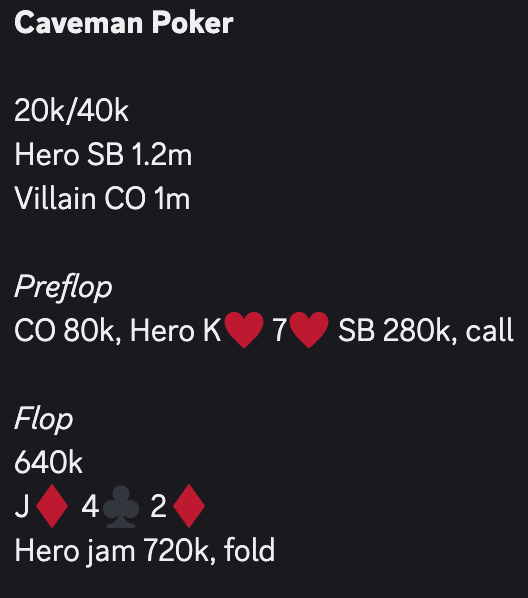
With 30bb and K7s here facing a 25bb HJ open all options seem reasonable.
We don't want to play for stacks with a hand as weak as K7 so fold can't be terrible.
This hand has decent equity and playability postflop though, so call is probably fine too.
We also want bluffs and we block some strong hands so 3b seems decent.
On the flop we have absolutely nothing and probably don't want to put any more chips into the pot.
Solver Ideas
My 3b strategy in this spot matches the solver and is heavily influenced by 2 factors: Stack depth and ICM pressure.
The shallower we are, the more polarized our 3-bets should be.
When we're deep we 3b a linear range because we can just call a 4b with our medium strength playable stuff like QJs and try to outflop our opponents.
But at 25bb we want our 3b hands to be either slam dunk calloffs vs a jam or easy folds. Hands like KJs/QJs are terrible small 3-bets because they're too good to fold but you're always a dog vs the jamming range. At this depth we prefer the weaker KJo/K6s stuff that can comfortably fold to a jam.
Under ICM pressure the main adjustment we make is to prefer Ax and Kx as 3-bets because it's much more important to block the 4b jams than it is to have good all in equity.
Nearing the end of Day 2 we're in a decently heavy ICM spot. At 25bb 3 tables left in a 1000 entry tournament (closest I could find) solver mixes 3b with K7s:

Facing our 3b, the HJ should mostly play jam/fold. Under this much ICM pressure you don't really want to be calling 3-bets at this stack depth. The solver has a 15% flat range protected by AA but this is difficult for a human to navigate postflop:

Deeper Thoughts
It was pretty clear to me from watching my opponent in the tank that he was not trapping me with AA.
Earlier in the tournament this same opponent had gone into the tank when I 3b jammed on him before he eventually folded A5o face up. I thought that should have been an easy fold and made a too verbal note that he was a less studied player.
So in this spot when he called my 3b I thought he most likely had a hand that should have jammed preflop like a middling pair or a middling suited broadway.
I knew that theoretically I should never jam this flop. It's dry so I should cbet for a small size much of the time and give up with my airballs like this one.
Against this player I thought that if I bet tiny he would continue all his pocket pairs. Then if I jammed the turn he might feel priced in to call.
But if he didn't have the courage to go all in preflop he probably wouldn't be able to find a hero call now. So I went full caveman and shipped it with an airball. He tanked but did eventually fold.
At the end of the night when we were bagging he said he had folded 55.
Jeremy Becker said something on the Suited Kings podcast once that stuck with me about how in order to win tournaments sometimes you need to win the pots that you're not supposed to win. This felt like one of those pots. I don't think the solver wins this one. The caveman does.
Tournament Summary
This was my best performance of the summer. I played strong poker throughout all 3 days and even had the chip lead at the final table before a couple incorrect river calls and some bad luck ran me out of the tournament. I took 6th place out of 1,512 players for $165,300. And unlike my other 6-figure score of the summer where I had sold action, in this one I had 100% of myself.
If He Dies, He Dies
MSPT Main Event Day 2 with 14 players left
July 14th
$1100 buyin, 40k starting stack, 40m levels

Simple Strategy
Is 99 good enough to call off against a 31bb jam when we're on the the final table bubble? Only if you think your opponent never has overpairs.
Solver Ideas
The solver is not much help here because it never expects BTN to jam 30bb.
Deeper Thoughts
The button went all in quickly. He was not a strong pro but he didn't seem like a complete munson either. So I don't think he would be jamming QQ+ and potentially scaring me out with my hands he dominates.
Is he ever jamming JJ/TT here? Possibly yes. Except that he jammed so quickly. If he had one of those two hands I'm sure he would weigh his options before putting his above average chip stack at risk.
By the time the action was back on me I was convinced that this was truly and always one hand only: AK.
But even if your opponent shows you AK this isn't a trivial call. Do we really want to flip for 65bb on the final table bubble? I think yes.
There were only 60m chips in play. If I won this pot I would have 10m with 13 players left. Having a chip lead on the final table bubble is a smash spot. I would have been a big favorite for a podium finish.
With more chips this becomes a worse call. If I already had 10m chips for example, the prospect of flipping for half of it isn't as enticing because going from 10m to 15m isn't nearly as beneficial as going from 5m to 10m.
I'm pretty at peace with this call off even though I lost. Sometimes you have to be willing to die.
Tournament Summary
Shortly after losing that big flip I busted to exit in 13th out of 1,495 players for $16,594.
My deep run in this one coupled with a small cash on many bullets in the following $1600 MSPT Major saw me break about even on the MSPTs this summer. But it also put me into first place for the MSPT Player of the Year race. Which means I'll be playing a lot more MSPTs the rest of the year chasing that title.
Many poker coaches will tell you that sleeping well, eating healthy, and avoiding drugs and alcohol are the keys to maintaining a healthy mindset that is conducive to winning poker. And yet Shaun Deeb is winning the WSOP player of the year race.

I had a very winning summer in Vegas, and I wouldn't say I lived the most healthy life. I drank some. I worked out none. I ate a lot of fast food. I remember on day 2 at Aria thinking my diet was actually an advantage because we had no dinner break but I just needed a slice of pizza and I'd be good to go.
I think the most important factor in poker win rate is your strategic knowledge of the game. Good nutrition and healthy sleep habits can help you play your A game more often but that doesn't really matter if your A game sucks.
My poker game has improved so much in the past couple years. Some of that is thanks to coaching, some of it comes from individual study, and some of it is just reps. Ultimately though I think I won because I played some damn good poker.


Comments